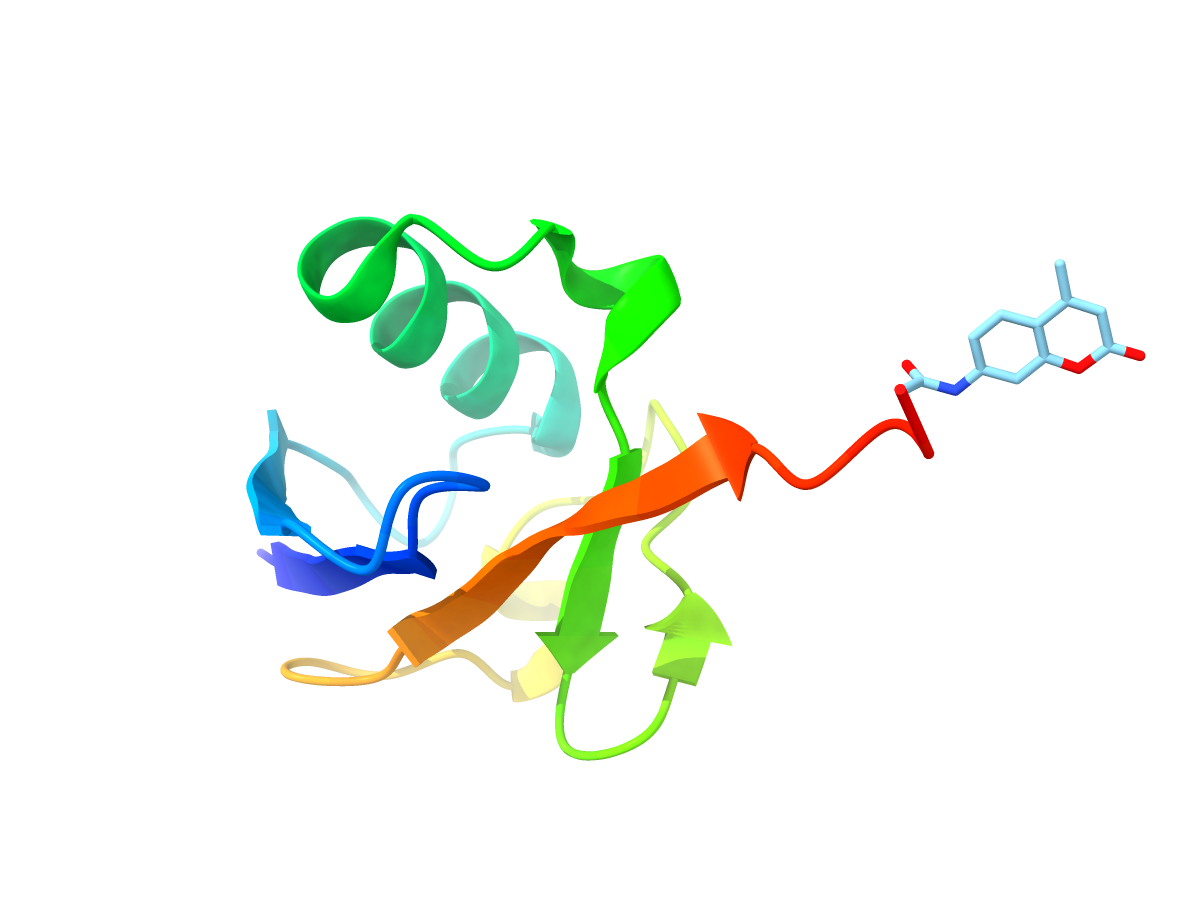
QW-001
Fluorescence window — excitation (left) to emission (right)
| Cat. No. | QW-001 |
| Categories | Fluorogenic Substrate、Activity-Based Probe |
| Sequence | MQIFVKTLTGKTITLEVEPSDTIENVKAKIQDKEGIPPDQQRLIFAGKQLEDGRTLSDYNIQKESTLHLVLRLRGG |
| Molecular Weight | 8,722 Da |
| Specifications | 1mg / 5mg / Custom |
| Purity | ≥95% (HPLC) |
| Ex | 360 nm |
| Em | 460 nm |
| Storage | -80°C protected from light |
| Batch No. | Spec | Stock Qty | Grade | Status | COA |
|---|---|---|---|---|---|
| AMC0126003 | 200 μg | 3 | ≥95% | Available | - |
| AMC0126004 | 500 μg | 1 | ≥95% | Available | - |
| AMC0126001 | 50 μg | 7 | ≥95% | Available | - |
| AMC0126002 | 100 μg | 5 | ≥95% | Available | - |
Ub-AMC is a fluorogenic substrate in which the C-terminus of ubiquitin is covalently conjugated to the fluorescent reporter AMC (7-amino-4-methylcoumarin) via an isopeptide bond. It is the most widely used and highly cited classic tool reagent for deubiquitinase (DUB) activity assays.
In the intact Ub-AMC molecule, AMC fluorescence is effectively quenched by the ubiquitin moiety. Upon DUB-mediated cleavage of the C-terminal isopeptide bond, free AMC is released, generating a dramatic fluorescence increase (Ex 360 nm / Em 460 nm). The rate of fluorescence increase is directly proportional to DUB enzyme activity and can be monitored in real time using a fluorescence plate reader or spectrofluorometer.
Recommended final substrate concentration: 0.5–5 μM (adjust based on enzyme level). Use Tris-HCl (pH 7.4) with 1 mM DTT as reaction buffer. Initiate reaction by adding substrate and monitor fluorescence continuously for 30–60 min.